Following Lotte Konow Lund’s What She Said last year and Vibeke Tandberg’s surprisingly inspired They Live this spring, Tokyo-based Gardar Eide Einarsson is third up in Kode’s lavish run of major solo shows with Norwegian contemporary artists. Einarsson’s link to Bergen is his studies at the art academy here in the 1990s, before his career as a poster boy for neo-conceptualism (feat. Faldbakken) took off. Spanning thirty years, The Purpose of a System is What it Does is his biggest museum exhibition to date, and it overwhelms through the sheer number of works. They cover almost every available surface in the Stenersen building, underlining the archival impulse that runs through his oeuvre. Einarsson has a lot to say about power and resistance, but his collect-and-quote formula makes it hard to see exactly what.
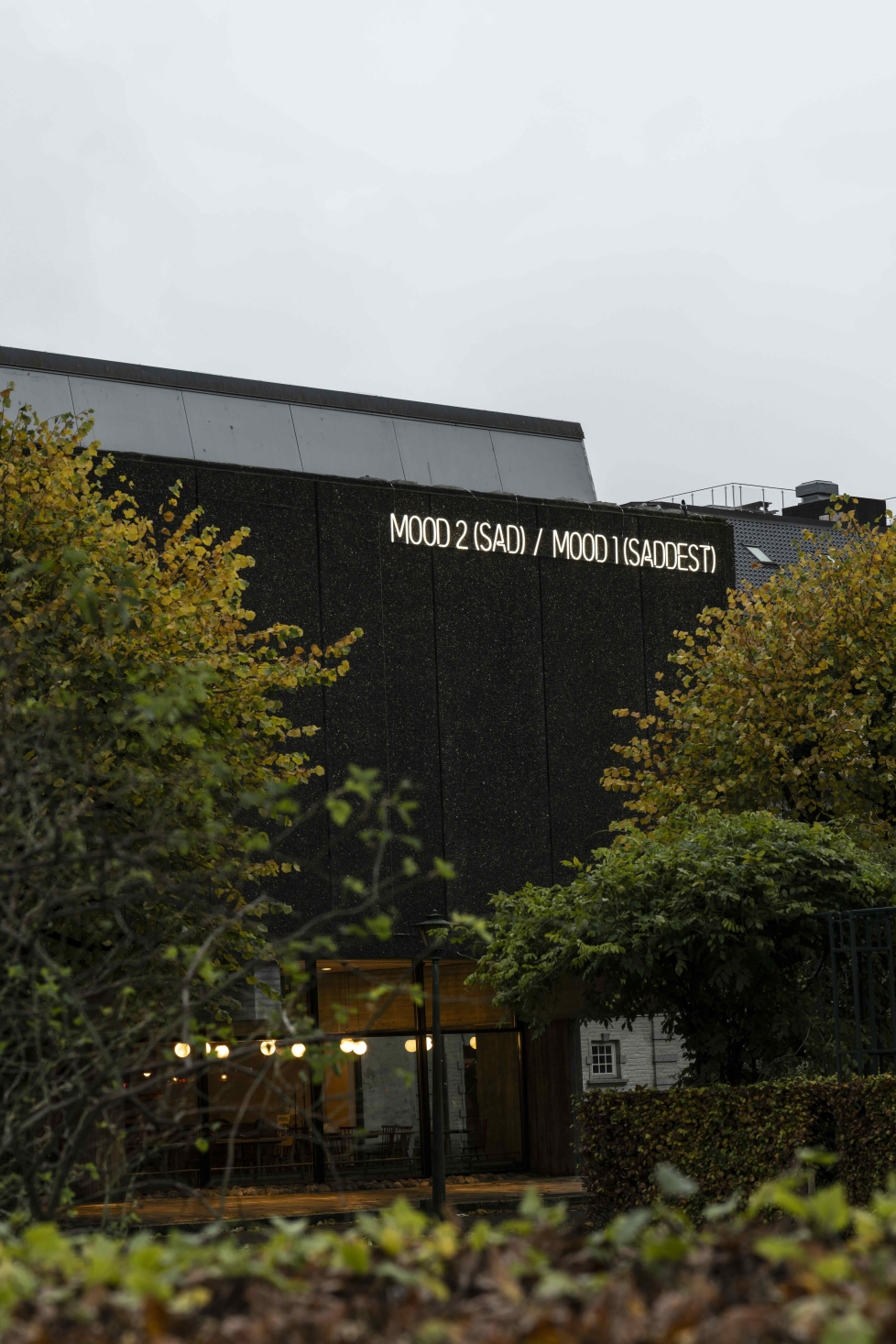
High up on the museum’s facade, the title of the work MOOD 2 SAD / MOOD 1 SADDEST (2026) is spelled out in glowing white letters. It refers to the British radio playlists used to manipulate collective moods during national emergencies, especially when members of the royal family fall ill or die. The work points out how ‘independent media’, whether by their own volition or on instruction, act on behalf of those in power to help manufacture consent. This coordination of media and the apparatus of power was recently on display close to home with our own King Harald’s passing. It is an opening motif that announces Einarsson’s analytical ambition, in which art is a tool for uncovering hidden aspects of our reality.
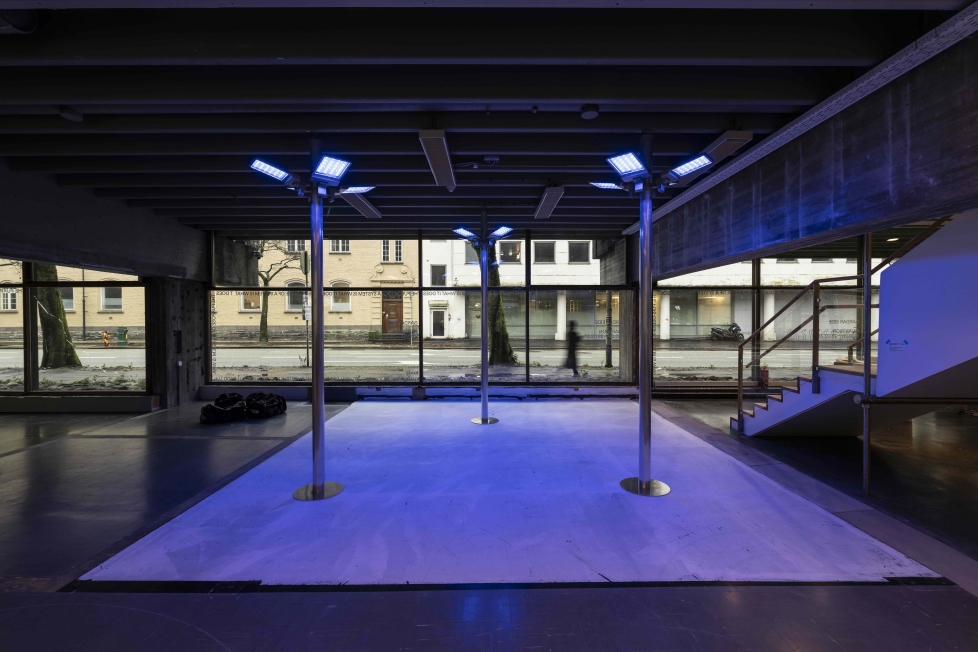
Einarsson shows us things as they are, without overt moralising. Instead, the aim is to bring the workings of power into view with clinical precision. Visible from street level through windows that are usually covered with foil, a crowded selection of works are bathed in a blue light emanating from three street lamps (Distinct Functional Layers Help Establish Hierarchy and Order, 2016). The blue light recalls a measure put in place in Japanese metro stations to prevent suicides. Seen through a local lens, though, it is more reminiscent of the lighting installed in public toilets to make it hard to inject drugs.
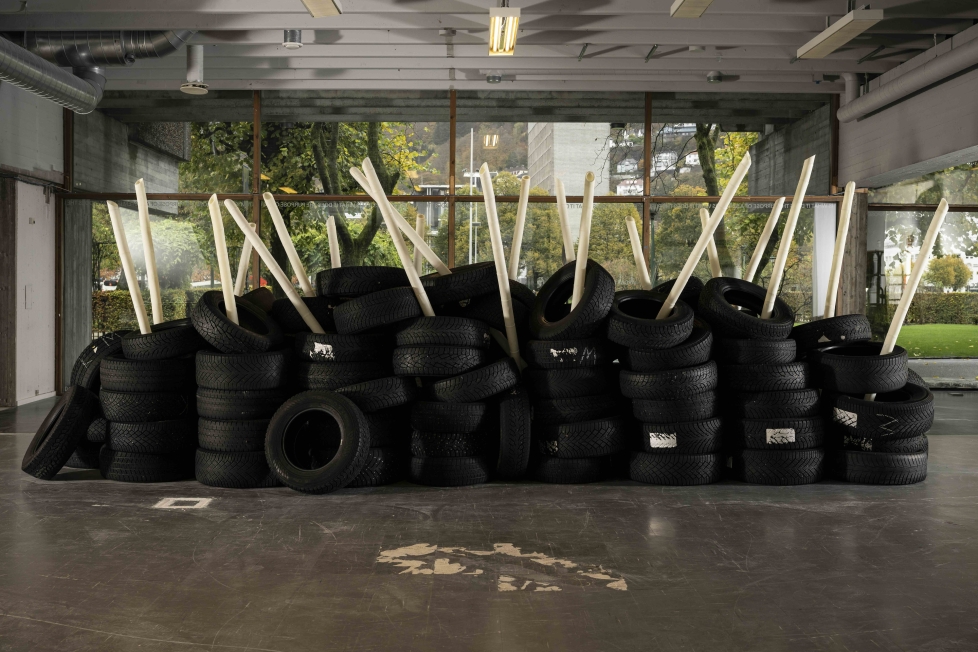
The expressions and tools of counter-power, or rebellion, are also made visible in the same register. Next to a huge stack of car tyres and white bamboo poles (Barricade (Bergen), 2011/2026) hangs a framed, vandalised May Day poster. Printed calls to strike have been supplemented with the addition “No strike!”, and a pen drawing of a penis ejaculating or pissing in the direction of a silhouette of strikers protesting (I can’t find the work’s title in the ten (!) page-long overview). Each of these readymades and reconstructions comes with its own references. They all seem to deal with asymmetric power struggles and manipulation of the public. Poised between irony and earnestness, Einarsson’s poster is emblematic of this mildly resigned system critique.
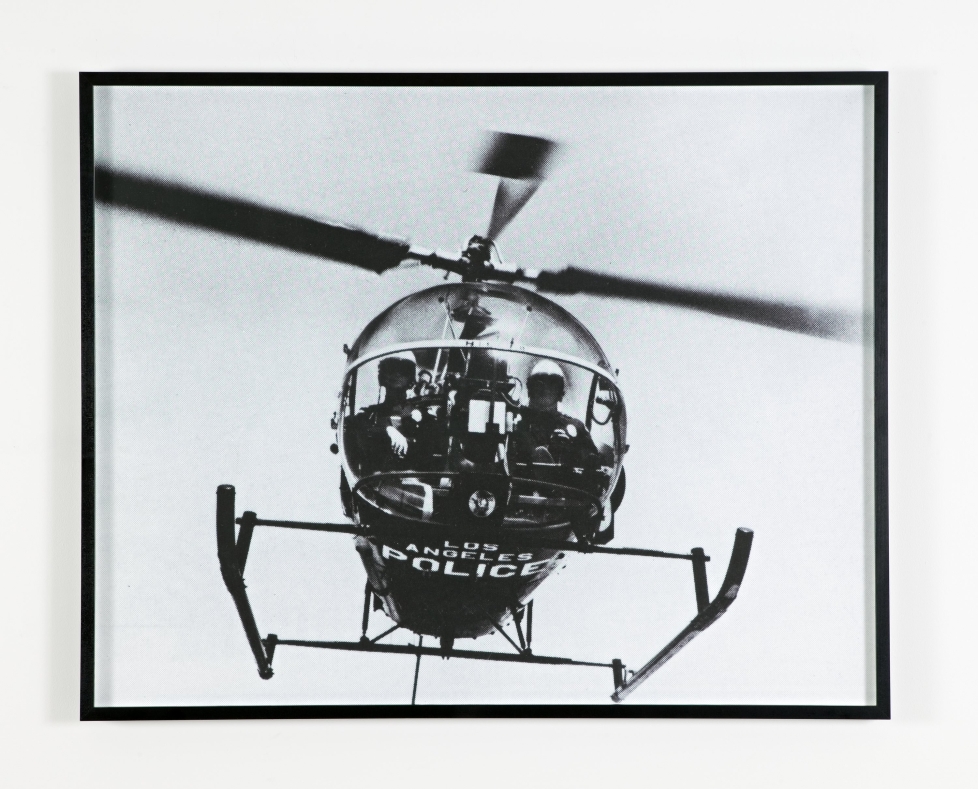
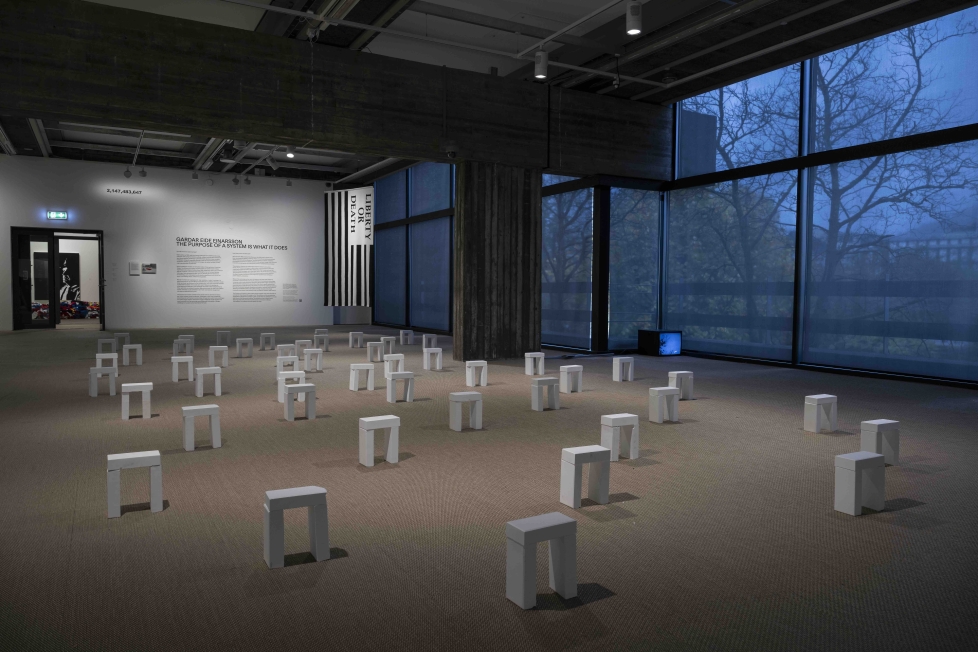
The exhibition largely continues along the same lines. In the main gallery, plaster bricks in sets of three form fifty triumphal arches on the floor, much like the bricks the 2019 pro-democracy protesters in Hong Kong laid out, serving both as weapons depot and roadblock (Our Arcs of Triumph, 2025). A text painting on a partition wall nearby (Untitled Wall Painting (Total Revolution), 2001) calls to mind countless other uprisings, French ones in particular, both past and recent, fuelled by promises of uncovering the metaphorical beach beneath the paving stones. A framed print of the front of an LAPD helicopter seen from below (Untitled (Helicopter), 2006) takes us across the pond and recalls the riots following the police beating of Rodney King. All of it is seen with the same coolly registering gaze, as if he were watching these dramas unfold through the eyes of an algorithm gathering data.
Scattered in smaller groups throughout the space, a play between both recognisable and more obscure figures from Einarsson’s oeuvre is staged. Attention is drawn towards defeated protest movements, police strategies for infiltration and surveillance, and institutions that serve the interests of capital. Three tables hold twelve spray-painted crypto mining rigs, titled after different RAL colours (2022). On the surrounding walls hang colourful representations of powerful media corporations with ties to financial and political elites. A canvas bears Russia Today’s logo, painted in green acrylic (Russia Today, 2019). A textile banner in Economist red promotes a neoliberal ideal of freedom (Untitled (Liberty), 2007). Another banner, in pale Financial Times pink, reads: “The good old days are gone and they won’t return.” As if there were any doubt.
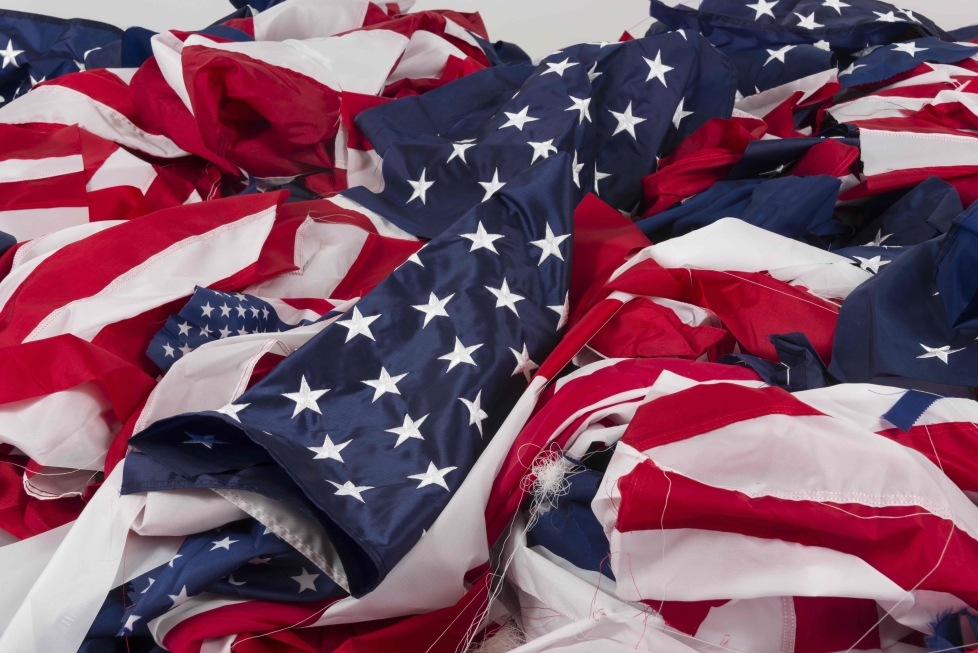
Geographically, Einarsson mostly refers to the US and Asia, but Europe and Norway also feature. On the floor of the next room lie three piles of waste from flag production. One is multicoloured (Untitled (Flagwaste EU), 2015), the other two only red, white, and blue. The largest shows torn stars and stripes (Flagwaste (US), 2014), the smallest and most recent, ruined crosses (Flagwaste (Norway), 2026). In a black box behind the puny pile, a 1998 news segment plays on a loop, reporting on how a failed opening stunt created chaos in a furniture store in Oslo. Where frustrated crowds elsewhere battle predatory capitalists and authoritarian regimes, it takes unfulfilled promises of gift cards to bring Norwegians together as a mob (lol).
The overwhelming multitude of windows Einarsson opens onto realities outside the museum reminds me of what documentary filmmaker Adam Curtis aptly captures in the title of his two short video essays, Oh Dearism (2009 and 2014). Here he describes how different human-caused crises and catastrophes are broadcast with the effect of putting the receiver in a state of perpetual inertia, where the only (or rather simplest) available response is a powerless “Oh dear.” Einarsson also shares Curtis’s capacity for tracing depressing connections across time and space. But while Curtis is eager to draw the conclusions for us, Einarsson is content with bringing the puzzle pieces of misery into view.
The activist temperament and the earnest and often autobiographical subject position that prevail in political art today make Einarsson’s aspirational analytical mode feel somewhat antiquated. With stoic restraint teetering on the provocatively nonchalant, he sketches out a world with no room for illusions, one that has of late taken a sharp turn towards the openly fascist and anti-human. Between the lines lurks a story of how ideals of a level playing field and democracy are being pulverised along with the rules-based world order. Einarsson’s invitation to acknowledge our ongoing slide into disaster makes for a stylish, numbing doomscroll. But it is not entirely without hope. Perhaps the beach will be there one day.
Translated from Norwegian